
Reviewed · KAYAKING ISLAND TRIPS
Guided 5-Day Kayak & Wildcamp the Archipelago of Sweden
Sweden’s outer archipelago is best understood from a kayak. You paddle past pine-covered islands, bare skerries, old villages, lighthouse outposts, and quiet coves, then pull ashore and make camp wherever the day ends. This five-day wild-camping trip turns a complicated outdoor trip into a fairly simple one: show up in Norrköping, load your boat, and let the guide handle the route, food, and gear.
I like the small group of eight, which should make instruction and daily decisions more personal. I also like that high-grade kayaking, camping, and cooking equipment is included, along with every meal and return transport to Saint Anna. The main thing to consider is the effort. Some days are long, the sea can be exposed, and the route may change with the weather. You must be at least 18 and comfortable spending four nights outdoors.
Key points to know before you book
- Remote island camping: You sleep in wild camps on islands such as Aspöja, Missjö, and Ytterö, not in hotels or permanent cabins.
- A real sea-kayaking route: The trip reaches the outer archipelago, with open-water crossings and a weather-dependent attempt at Häradskär Lighthouse.
- Small group size: No more than eight people join, keeping the trip personal and easier to manage.
- Everything important is supplied: Kayaks, camping equipment, cooking gear, food, water, snacks, hot drinks, and a detailed guidebook are included.
- Wild food with a practical edge: Breakfast, lunch, dinner, and snacks are provided for all five days, so you do not need to carry your own meal plan.
- Beginner-friendly, but not effortless: Most people can participate, and one review specifically describes the trip as suitable for a complete beginner, but you still need stamina for long paddles.
Why this Swedish kayaking trip feels different
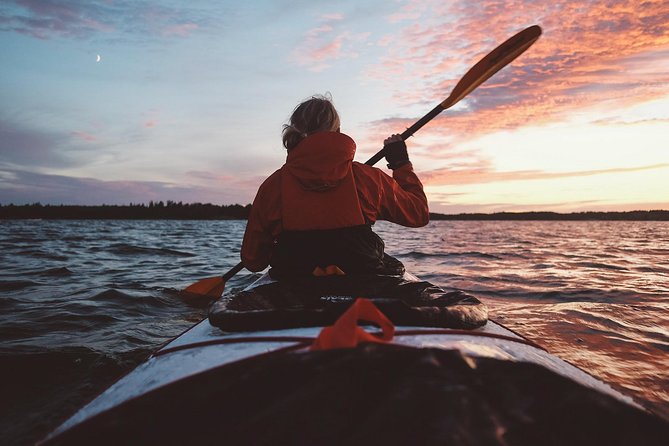
Many outdoor tours give you a short taste of nature before returning you to a road, lodge, or town. This one removes that safety net for several days. You paddle away from the mainland, carry only what fits in the kayak, and watch the islands change from forested inland outcrops to low, wind-shaped rocks at the edge of the sea.
The route is in the Saint Anna and Missjö archipelagos, a maze of islands and islets along Sweden’s east coast. You will not simply visit one scenic island and turn around. The plan carries you northeast, southeast, and south through different parts of the island chain, with the route adjusted when conditions require it.
That variety gives the trip its appeal. One day may bring a sheltered inlet and old pine trees. The next may offer a bare horizon, seabirds, and a demanding paddle between exposed skerries. By the final day, you have moved through a broad slice of the archipelago under your own power.
The tour is limited to eight people. That matters on a trip where everyone helps load boats, organize camp, cook, and make weather decisions. A large group could turn a quiet island trip into a queue at the launch site. Here, you should have more direct contact with the guide and a better chance to get help with paddling technique or camp tasks.
The feedback is exceptionally strong, with a five-star rating from 73 reviews and 100 percent recommending the trip. The praise focuses on the guides, excellent equipment, food, and relaxed group atmosphere. One person gives special thanks to Rob and says the trip worked even for a complete beginner. That does not erase the physical demands, but it is useful if you are unsure about your first multi-day kayak trip.
More Kayaking Island Trips in Sweden:
- 1-Day Small-Group Stockholm Archipelago Kayak Tour
★ 5.0 · 266 reviews - Stockholm: Archipelago Islands Kayak Tour and Outdoor Picnic
★ 4.9 · 227 reviews - Stockholm Archipelago Tour by Kayak
★ 5.0 · 99 reviews
Day 1: Loading the kayaks and reaching Aspöja
Your pickup is at 10:00 a.m. in Norrköping, either at the train station or at your hotel or hostel. From there, return transport takes you to Saint Anna, where the kayaks, food, water, and camping gear are waiting at the launch site.
The first practical task is repacking. Your clothes go into dry bags, and your supplies are loaded into the kayak. This is not glamorous, but it is one of the most important skills on a sea-kayaking trip. You need to keep weight balanced, protect clothing from spray, and leave room for items you will want during the day.
The launch is in a sheltered bay, which gives you a gentler start. After rounding the first islands, you begin to see the full scale of the archipelago, with islands spreading in many directions. The first paddle is listed at about two hours, but Day 1 continues with a longer route toward Aspöja.
You pass forested islands and small islets where ducks, swans, and grey herons breed. White-tailed eagles are also regularly seen in the area, since they nest in large trees nearby. The point is not to turn the trip into a bird-watching expedition, but the setting gives you plenty to notice while you paddle.
The route enters Uggelholmarna Nature Reserve. Three-hundred-year-old pine and linden trees grow there, and the open woodland makes a good place to stretch your legs. After time on the water, even a short walk feels welcome.
The day continues toward the narrow inlet between Lammskär and Kalvskär, where the islands create a sheltered atoll-like formation. You finish near the islets south of Aspöja, one of the most scenic places on the route and a strong spot for sunset.
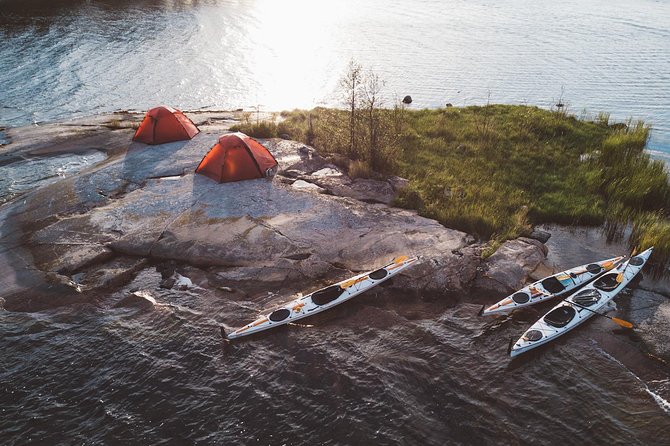
The first night teaches you what this trip really involves. You are not arriving at a prepared campground with a shop nearby. The guide finds a suitable place, and the group sets up with the supplied tents and cooking equipment. That simplicity is part of the appeal, but it also means you should keep your personal packing tidy from the start.
Day 2: Open water, seabirds, and Kupa Klint
Day 2 heads southeast into the outer archipelago. This is a more exposed section, with barren, wind-shaped islets and a broad blue horizon. The scenery becomes less sheltered and more elemental.
The birdlife is a major feature here. You might see gulls, Arctic terns, black guillemots, mergansers, velvet scoters, eiders, shelducks, oystercatchers, and redshanks. Great cormorants and white-tailed eagles are common, while Arctic skuas and ospreys are possible sightings. Seals may also appear if conditions and luck cooperate.
This is also described as a strenuous paddling day. That word matters. The route is not only a series of short scenic outings. You should expect several hours of steady movement, wind, waves, and the need to stay alert around open water.
The payoff is Kupa Klint, a famous navigation mark and lookout with wide views over the hundreds of skerries in the Missjö Archipelago. From there, you enter the outer band of rocks and continue toward the larger island of Missjö and its parallel islands.
Your guide’s local route knowledge is especially useful on this day. The islands can look confusing from water level, and a sheltered campsite is not always obvious from a distance. Finding a protected place for the night makes a real difference after a demanding paddle.
If you are new to kayaking, this is the day to take care of your hands, shoulders, and sitting position. Adjust your clothing and paddle grip early. Small problems become much less pleasant after several hours on the water.
Day 3: Harstena village and a night on Ytterö
The route turns south toward Harstena, the most visited island in this part of the archipelago. You approach through a narrow inlet, with the village appearing ahead in an unusually picturesque setting.
Harstena gives the trip a welcome change of pace. Instead of seeing only uninhabited islands, you can walk through a historic village, visit the museum in the old school, and stop at the bakery for cinnamon swirls. The break is not just about taking photographs. It gives you a look at how people have lived among these islands, where the sea has long shaped work, travel, and daily life.
The village visit also breaks up the rhythm of wild camping. After two nights of moving between skerries and forested islands, a small settlement can feel remarkably social and comfortable. You should enjoy it without expecting a long stop filled with attractions. The charm is in the scale, the setting, and the sense of a place that has not been built for mass tourism.
After Harstena, you paddle southeast toward Ytterö. This island offers smooth rocky beaches, old, twisted pine trees, and a position close to the open sea. The group aims for higher ground to take in the view across the islands and out toward the horizon.
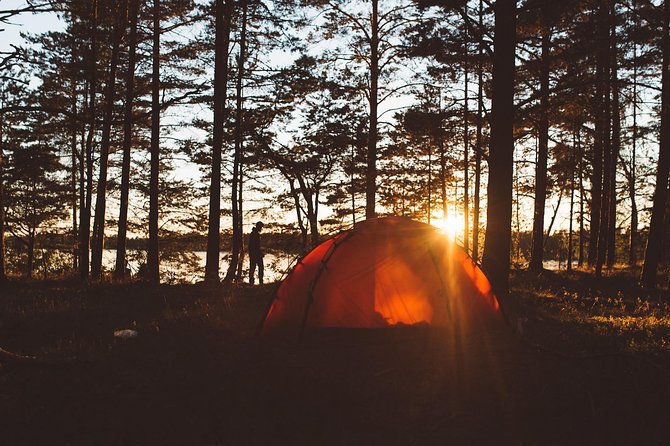
The night here is likely to feel more exposed than the first two. You may hear waves breaking against the smooth rocks and birds calling from the small islets nearby. That is the kind of quiet you get on a remote island, but it is not hotel quiet. Wind, waves, and bird calls remain part of the night.
Ytterö is also a good reminder that the experience is not only about paddling distance. The best moments may come after the boats are pulled ashore, when you have time to walk, cook, watch the light change, and simply sit without a town around you.
More Five-Day Trips in Sweden:
- 5-Day Kayak & Wildcamp the Archipelago of Sweden – Self-guided
★ 5.0 · 48 reviews - Galapagos Intensive 5 days, land base (3Islands) Excludes galapagos flight
★ 4.5 · 55 reviews
Day 4: The weather-dependent crossing to Häradskär
Day 4 is the most ambitious part of the route. The target is Häradskär Lighthouse, an old red iron lighthouse on the last outpost of the archipelago, right on the open sea.
The route passes Gubbö, where you climb a hill for views over this part of the islands. You then paddle south through the island groups around Laxvarp and decide whether conditions allow the crossing to Häradskär.
The weather qualification is important. This is not a promised lighthouse visit at any cost. A responsible guide will consider wind, waves, visibility, and the group’s ability before making an exposed crossing. If conditions are not right, the route can remain closer to shelter. That may disappoint you, but it is the correct approach for a sea trip.
If you do reach Häradskär, the setting is dramatic in a quiet way. The lighthouse appears after the crossing, with flat rocks, bird calls, and the rhythmic sound of the sea. You are as far out as the route goes, and the sense of distance from the mainland is the reward.
This day may be the clearest test of whether the tour suits you. A beginner can join, but a beginner should not mistake that for a gentle holiday. You need to follow instructions, keep a steady pace, and accept that the day’s plan depends on the water.
Day 5: Fångö’s copper mine and the paddle back
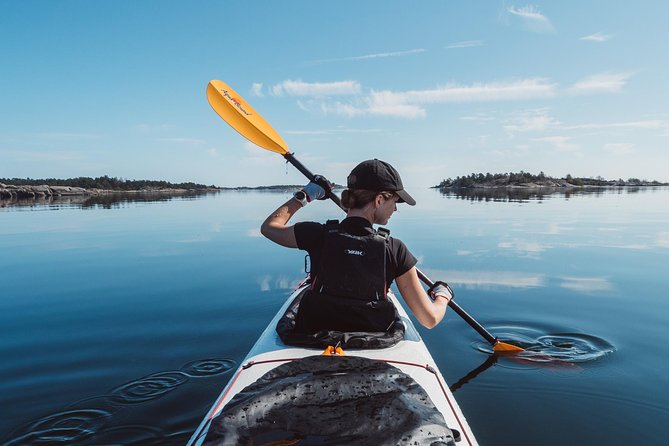
The final morning starts south of Fångö island. After breakfast and a last swim, you begin the return route through the island chain.
You stop at the abandoned copper mine on Fångö, adding another piece of local history to the natural scenery. The visit is brief compared with the hours on the water, but it gives the final day a point of interest beyond simply heading back.
From there, you round the island and paddle through a small canal toward Fyrudden. A short paddle west brings you to the mainland and the finish point at Fyruddens Gästhamn.
The final day is listed at about six hours, so do not expect a quick morning exit. You still have a substantial paddle, packing, and return transport ahead. That timing makes the provided breakfast and lunch useful, since you can focus on the route rather than finding food in the middle of the day.
By the finish, the group has shared several long days of work and camp life. You will have packed boats together, eaten from the same camp kitchen, dealt with weather, and learned the rhythm of moving by kayak. That shared routine is a large part of the trip’s social appeal.
What the $1,629 price includes
At $1,629.22 per person, this is not a cheap way to see Sweden. The value depends on how much of the outdoor setup you would otherwise need to arrange yourself.
The fee includes an experienced kayaking guide, kayaks, camping gear, cooking equipment, food, water, a detailed guidebook, and return transport between Norrköping and Saint Anna. You receive breakfast, lunch, dinner, and snacks throughout the five days, plus coffee, tea, and soft drinks.
The high-quality equipment is a real cost saver if you do not already own a sea kayak, tent, dry bags, and camp kitchen. The trip also removes the planning burden of choosing campsites, carrying a food supply, and working out a route through a maze of islands.
You still need to pay for flights, your airport transfer to Norrköping, and alcoholic drinks. The transport to the launch begins in Norrköping, not at the airport, so include that extra step in your budget. Stockholm Skavsta has a 55-minute airport shuttle to Norrköping. Arlanda has a direct train that takes about two hours. Linköping City Airport connects by train in about 25 minutes, and Norrköping Airport is a short cab ride from town.
For someone who already owns all the gear and plans trips independently, the price may feel high. For someone who wants a guided route, strong equipment, full meals, and a small group, the package is easier to justify.
Food, equipment, and the practical side of wild camping
Food is one of the strongest parts of the offer. Every breakfast, lunch, dinner, and snack is supplied, along with hot drinks and soft drinks. You do not need to design a five-day menu or calculate how much food fits in a kayak.
One review gives the food especially high praise, calling it unbelievably good. That matters because meals become a major part of camp life after a long paddle. A warm dinner and coffee are not small comforts when you are sleeping outdoors and working each day.
The gear is also repeatedly praised. You receive top-quality kayaking, camping, and cooking equipment rather than being asked to bring a basic personal kit. You should still check the final packing guidance before departure, especially for clothing and personal items, but the costly core equipment is covered.
The tour is offered in English. Confirmation arrives when you book, and free cancellation is available up to 24 hours before the start time. Changes or cancellations inside that window are not accepted for a refund.
Who should book this five-day archipelago trip
I would choose this trip if you want a genuine outdoor challenge without having to plan every detail yourself. It suits adults who enjoy quiet natural settings, simple camps, long days outside, and a strong sense of place.
It is also a good option for a first multi-day kayaking trip if you are reasonably fit and willing to learn. The small group and guide support help, and the available feedback includes a complete beginner who found the trip successful.
I would think twice if you want guaranteed sightseeing stops, fixed daily distances, or hotel comfort. The lighthouse visit depends on the weather, camps are wild, and some paddling days are strenuous. You should also be comfortable with the possibility that the route changes for safety.
Should you book it?
Book this trip if your idea of a good Swedish holiday includes remote islands, seabirds, simple camps, strong food, and several hours of paddling each day. The equipment, meals, guide, and small group make the high price easier to understand, especially if you do not own serious kayaking gear.
Skip it if you want a soft adventure or a quick taste of the coast. The best reason to go is not one single landmark. It is the full rhythm of moving between islands, sleeping beside the sea, and reaching the mainland with a shared expedition behind you.
FAQ
How long is the kayaking and wild-camping tour?
The tour lasts approximately five days, with kayaking, island walks, camping, meals, and route planning included throughout the trip.
Where does pickup take place?
Pickup is at 10:00 a.m. in Norrköping, either at the train station or at a hotel or hostel.
How many people can join the tour?
The group is limited to a maximum of eight travelers.
Is the tour available in English?
Yes. The experience is offered in English.
What equipment is included?
The tour includes kayaking equipment, camping gear, cooking gear, bottled water, and a detailed guidebook.
Are meals included?
Yes. Breakfast, lunch, snacks, and dinner are provided for all five days. Coffee, tea, and soft drinks are also included.
Is Häradskär Lighthouse guaranteed?
No. The visit depends on weather conditions. The guide assesses whether the group can safely make the exposed crossing.
What is the minimum age?
The minimum age is 18 years.
Is airport transportation included?
No. Airport transfers to Norrköping are not included. You must arrange your own connection to Norrköping before the 10:00 a.m. pickup.
Can I cancel for a full refund?
Yes, if you cancel at least 24 hours before the experience start time. Cancellations or changes made less than 24 hours before the start are not refunded.
Newest island reviews around Sweden
- Vaxholm & Stockholm Archipelago: Guided Excursion, Day Trip★ 4.8 · 41 reviews
- 6 Islands History Walking Tour in Karlskrona★ 5.0 · 4 reviews
- 5-Day Kayak & Wildcamp the Archipelago of Sweden – Self-guided★ 5.0 · 48 reviews
- 4-Day Kayak & Wildcamp the Archipelago of Sweden – Self-guided★ 5.0 · 16 reviews
- Culinary Kayaking Adventure – Saint Anna Archipelago of Sweden★ 5.0 · 7 reviews
- PRIVATE Sunset Kayaking in Stockholm Archipelago Nature Reserve★ 5.0 · 28 reviews
- 2-Day Small-Group Stockholm Archipelago Kayak Tour★ 5.0 · 25 reviews
- Stockholm Archipelago Boat Cruise, Gamla Stan Walking Tour★ 5.0 · 3 reviews
Kayaking Island Trips, compared.
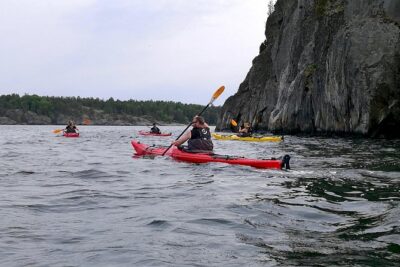
1-Day Small-Group Stockholm Archipelago Kayak Tour
Read our review →
Elafiti Islands Sea kayaking: Full-Day Bike and Kayak tour on Lopud and Šipan
Read our review →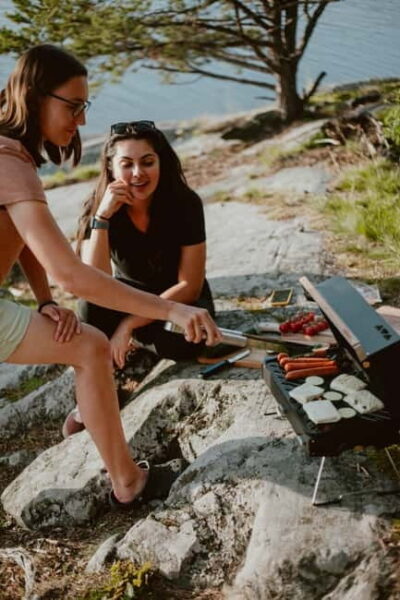
Archipelago Islands Kayak Tour and Outdoor Picnic
Read our review →
Kayaking tour around Vaxholm Archipelago with Fika
Read our review →
Island Hopping Tour A with Kayaking on Big Lagoon
Read our review →
4 Island Premium Yacht with Snorkeling & Clear Kayak
Read our review →
Browse the lists this tour appears in